

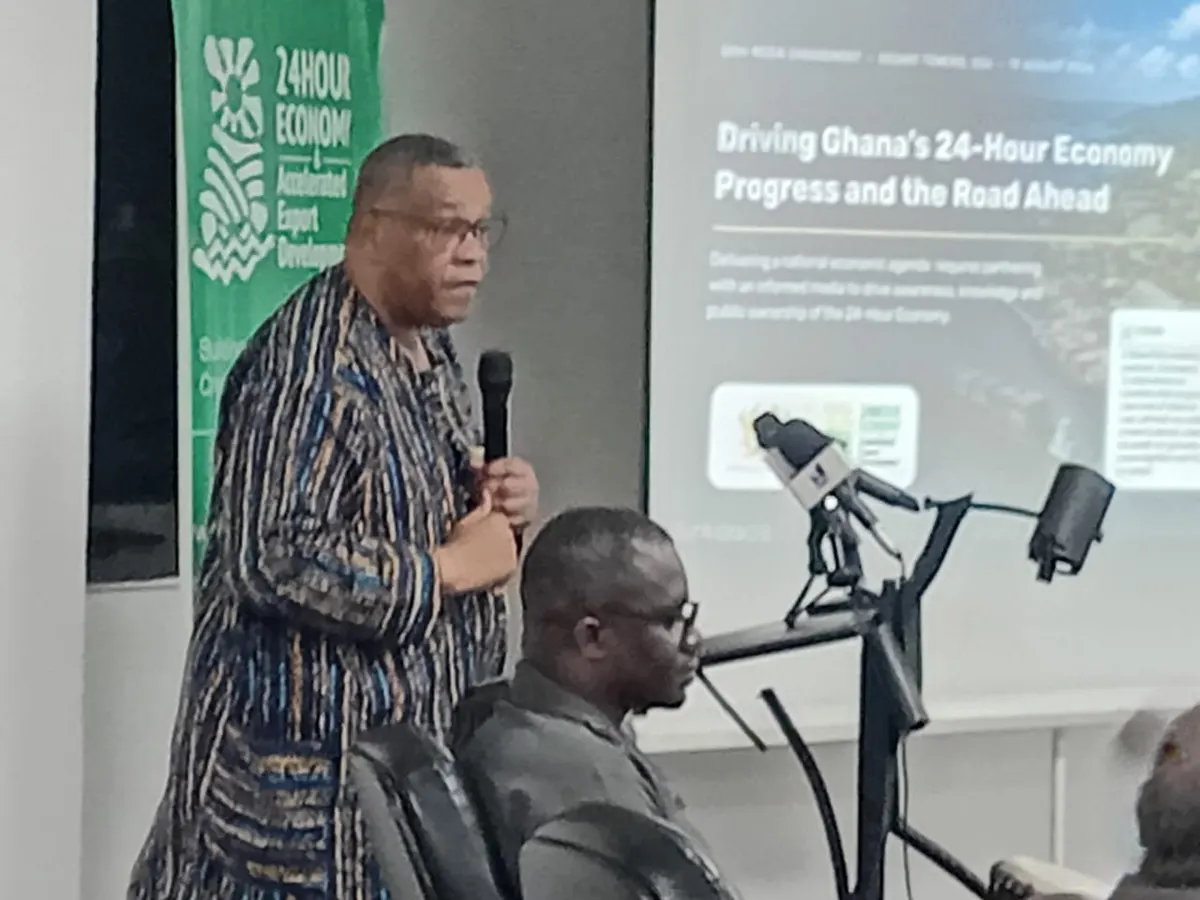

The Presidential Adviser on the 24-Hour Economy and Accelerated Export Development, Goosie Tanoh, has clarified that the 24-Hour Economy Secretariat has no responsibility for the government’s 24-Hour Markets project.
Mr. Tanoh said the development of the markets falls under the Ministry of Local Government, Chieftaincy and Religious Affairs and is funded through the District Assemblies Common Fund.
Speaking at a media briefing on August 19, he said his office had been wrongly associated with the project and had even been named in legal actions over demolitions linked to the initiative.
“The 24-Hour Markets Project is not our responsibility. We are not into development of markets. We don’t know anything about that,” he said.
Mr. Tanoh explained that the Secretariat had been sued over the demolition of buildings, despite having no involvement in the project.
He said the Secretariat’s lawyers would seek to have its name removed from the suits.
According to him, the 24-Hour Markets Project “belongs to the Ministry of Local Government, Chieftaincy and Religious Affairs,” while the funding comes from the District Assemblies Common Fund.
Controversy over 24-Hour Markets
The 24-Hour Markets initiative has attracted public attention following disputes over the demolition of existing structures and the allocation of land for the construction of new markets.
One of the recent controversies involved the demolition of a building housing the Aboabo branch of Sekyedumase Rural Bank in Kumasi.
The bank had previously indicated that it was in discussions with the Asokore Mampong Municipal Assembly regarding arrangements to relocate its operations to make way for the project.
According to the bank’s Chief Executive Officer, Afriyie Michael Kwabena, the Assembly had allocated an alternative location at the Asawase Market, but the bank needed regulatory approval before relocating.
He said the building was subsequently demolished without an official ejection notice.
The demolition reportedly resulted in damage to several bank properties and documents, although the bank said its customer data and records remained intact because of its network system.
The CEO also said the bank could not immediately account for about GH¢10 million that had reportedly been kept in its vault at the time of the demolition.
The Presiding Member of the Asokore Mampong Municipal Assembly, Mohammed Al-Jara, said the demolition occurred before the General Assembly had discussed the matter.
The bank has indicated that it may pursue legal action against the Assembly over the alleged damages.
Mr. Tanoh’s clarification is therefore intended to distinguish the 24-Hour Economy Secretariat from the market development programme amid the ongoing controversies surrounding its implementation.