

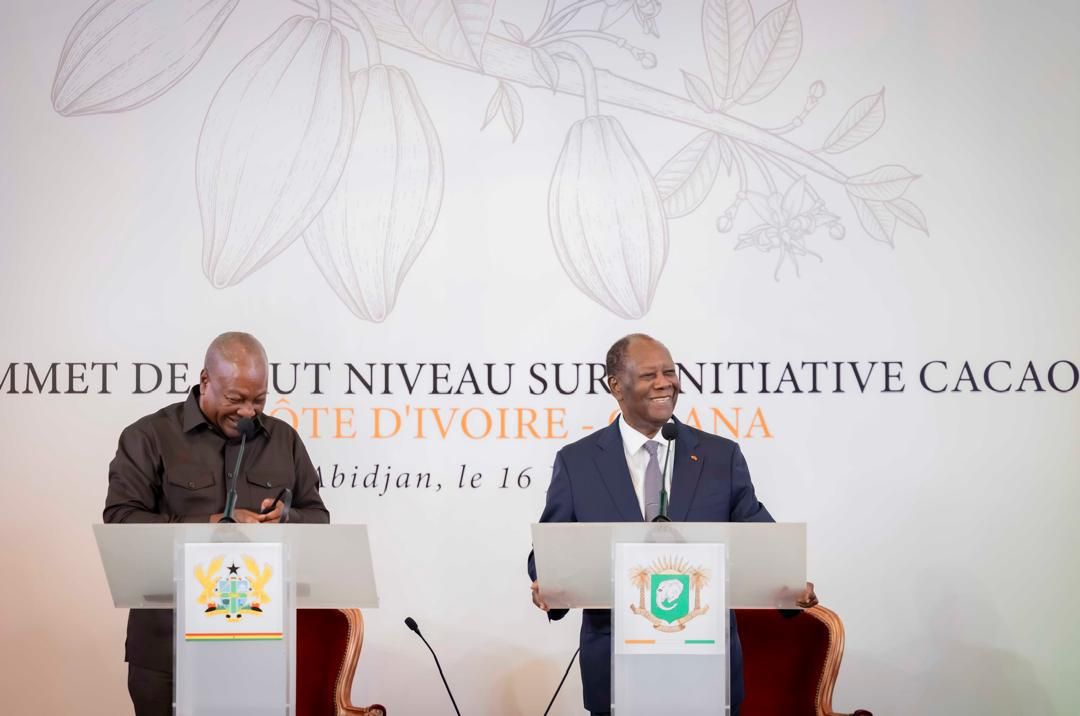

Ghana and Côte d’Ivoire have agreed to harmonize their cocoa farm-gate pricing policies as part of efforts to improve farmer incomes, reduce market distortions and strengthen the position of the two countries in the global cocoa market.
The agreement was contained in a Joint Declaration issued by President John Dramani Mahama of Ghana and President Alassane Ouattara of Côte d’Ivoire following the Côte d’Ivoire–Ghana High-Level Summit on the Future of the Cocoa Economy in Abidjan on Tuesday, June 16, 2026.
The two countries account for approximately 60% of global cocoa production, giving them significant influence over the future direction of the international cocoa industry.
Focus on cocoa farmer incomes
Under the agreement, Ghana and Côte d’Ivoire will work towards aligning their farm-gate pricing policies to improve producer remuneration and reduce unhealthy competition between the two countries.
The initiative will include greater market coordination, alignment of premiums and harmonisation of crop-season calendars.
The two governments believe the measures will strengthen their bargaining position in the international cocoa market while ensuring that cocoa farmers receive fairer compensation for their produce.
The leaders reaffirmed that fair remuneration for farmers is essential to the long-term sustainability of the cocoa sector, as well as economic justice and social stability in cocoa-growing communities.
Building on cocoa cooperation
Ghana and Côte d’Ivoire also highlighted the achievements of the Côte d’Ivoire–Ghana Cocoa Initiative (CIGCI).
Among the areas of cooperation are the introduction of the Living Income Differential (LID), efforts to coordinate cocoa marketing and price announcements, and collaboration on traceability and sustainable cocoa production standards.
Despite these developments, the two countries acknowledged that the sector continues to face several challenges, including international price volatility, illegal mining, climate change, the increasing use of cocoa substitutes and stricter sustainability requirements in international markets.
Expanding cooperation beyond prices
Beyond farm-gate pricing, Ghana and Côte d’Ivoire agreed to strengthen scientific cooperation to combat cocoa diseases, particularly Cocoa Swollen Shoot Virus Disease (CSSVD).
The countries will also promote greater cocoa processing and value addition, while encouraging increased consumption of cocoa products within the region.
The two governments further announced plans to expand the Côte d’Ivoire–Ghana Cocoa Initiative to other African cocoa-producing countries.
The broader objective is to improve regional coordination, harmonise cocoa-sector policies and strengthen Africa’s collective bargaining power in the global cocoa economy.