

By Eugene Davis
The Minority in Parliament has accused the Chief Executive Officer of the Ghana Gold Board (GoldBod) of effectively acknowledging a US$1.7 billion loss associated with the Domestic Gold Purchase Programme (DGPP) in 2025.
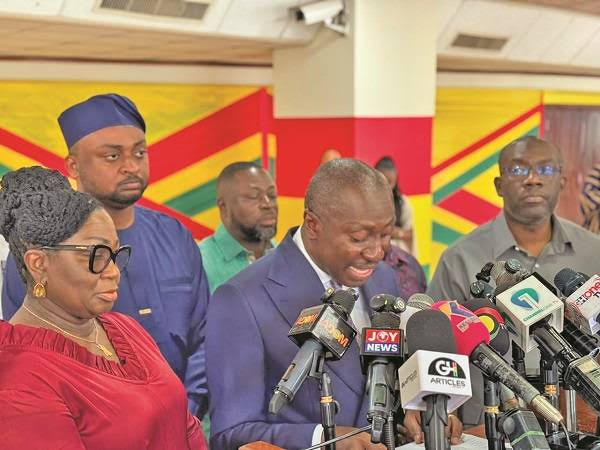
The Minority Leader, Osahen Alexander Kwamena Afenyo-Markin, made the claim in a statement responding to recent comments by the GoldBod CEO.
According to Mr Afenyo-Markin, the central issue is whether the Republic incurred a loss equivalent to about US$1.7 billion, or approximately GH¢22 billion, under the DGPP, a figure the Minority says was reported by the International Monetary Fund (IMF).
“The loss is admitted,” Mr Afenyo-Markin said, arguing that the GoldBod CEO did not dispute the reported figure but instead challenged who should bear responsibility for it.
The Minority Leader maintained that regardless of which public institution carries the loss on its balance sheet, the financial consequences ultimately affect taxpayers.
“This is public money, whichever state balance sheet it sits on,” he said.
Minority questions GoldBod’s fee income
The Minority has also questioned GoldBod’s reported income from the programme.
Mr Afenyo-Markin said the GoldBod CEO indicated that approximately GH¢133 billion in advances had been accounted for under the programme, with GoldBod receiving an assay fee and a 0.5% service fee.
Based on those figures, the Minority estimates that GoldBod generated about GH¢1 billion in fees.
The Minority further pointed to GoldBod’s reported GH¢907 million operational surplus, arguing that the surplus is smaller than the fees it reportedly received from the programme.
“Strip out the agency fees and there is no operational surplus to speak of,” Mr Afenyo-Markin said.
He argued that GoldBod should explain how its operational surplus relates to the wider financial outcome of the DGPP.
Minority challenges GoldBod’s position on programme benefits
The Minority has also questioned what it describes as an inconsistency in GoldBod’s position on the economic effects of the domestic gold purchasing initiative.
According to Mr Afenyo-Markin, GoldBod has highlighted the programme’s contribution to positive economic developments, including the reported 41% appreciation of the cedi, an increase in international reserves from US$8.9 billion to US$13 billion, and falling inflation.
He argued that an institution taking credit for the programme’s benefits should also provide clarity on its financial costs.
“An institution that claims authorship of the benefits cannot describe itself as a passive agent when the costs are counted,” the statement said.
Questions raised over GoldBod’s financing arrangements
The Minority has further raised concerns about changes in how the government’s gold purchasing initiatives are being financed.
Mr Afenyo-Markin said responsibility for the implementation costs of the Ghana Accelerated National Gold Refinery Agenda Programme (GANRAP) moved from the Bank of Ghana to the Ministry of Finance in July 2026.
He added that GoldBod was seeking to raise funds independently from August.
The Minority described the changes as evidence that the financing framework remains unsettled.
“Three funding arrangements in six months is not a settled model,” Mr Afenyo-Markin said.
Minority demands accountability over reported GH¢22bn loss
The Minority said the reported GH¢22 billion loss cited in the IMF’s Sixth Country Report, numbered 26/213 and issued in August 2026, must be fully accounted for.
It argued that the issue should not be reduced to a disagreement over which government institution technically carries the loss.
According to the Minority, the matter raises broader questions about fiscal responsibility, transparency and the management of public funds.
Afenyo-Markin criticises GoldBod CEO’s response
The Minority Leader also criticised the tone of the GoldBod CEO’s response, particularly his reported reference to a brothel.
Mr Afenyo-Markin described the reference as inappropriate in a discussion involving public funds and financial accountability.
“Ghanaians asked for figures. They were given insults. The figures are still outstanding,” he said.
Analysis: GoldBod controversy centres on reconciliation of the figures
The latest exchange places greater emphasis on the accounting relationship between the reported DGPP loss and GoldBod’s financial performance.
GoldBod’s reported GH¢907 million operational surplus, by itself, does not establish whether the wider domestic gold purchase programme generated an overall gain or loss for the state. The key issue is how GoldBod’s operational results, fees, financing costs and the reported US$1.7 billion programme-level loss relate to one another.
The Minority’s argument over fees also raises questions about how GoldBod’s financial performance should be assessed. If GoldBod earned substantial fees from administering the programme while the state incurred a significantly larger programme-level loss, the government may need to provide a detailed reconciliation of the figures.
The debate also highlights the importance of clearly establishing who bears the financial risk associated with the programme. Changes in financing arrangements involving the Bank of Ghana, the Ministry of Finance and GoldBod make transparency over the funding structure particularly important.
Ultimately, the controversy will require more than competing political statements. A clear reconciliation of funds advanced, gold purchased, valuation, fees earned, financing costs, operational results and the methodology behind the reported US$1.7 billion loss would help establish the actual financial position.
For taxpayers, the central question remains whether the reported loss represents a final cost to the Republic and, if so, where that loss is recorded and who is responsible for it.


[…] Minority’s argument is therefore not that the concept of using gold to strengthen Ghana’s reserves was […]