


By Eugene Davis
The government has reminded mining companies operating in Ghana that mineral rights are a privilege rather than an absolute entitlement and come with legal and regulatory obligations.
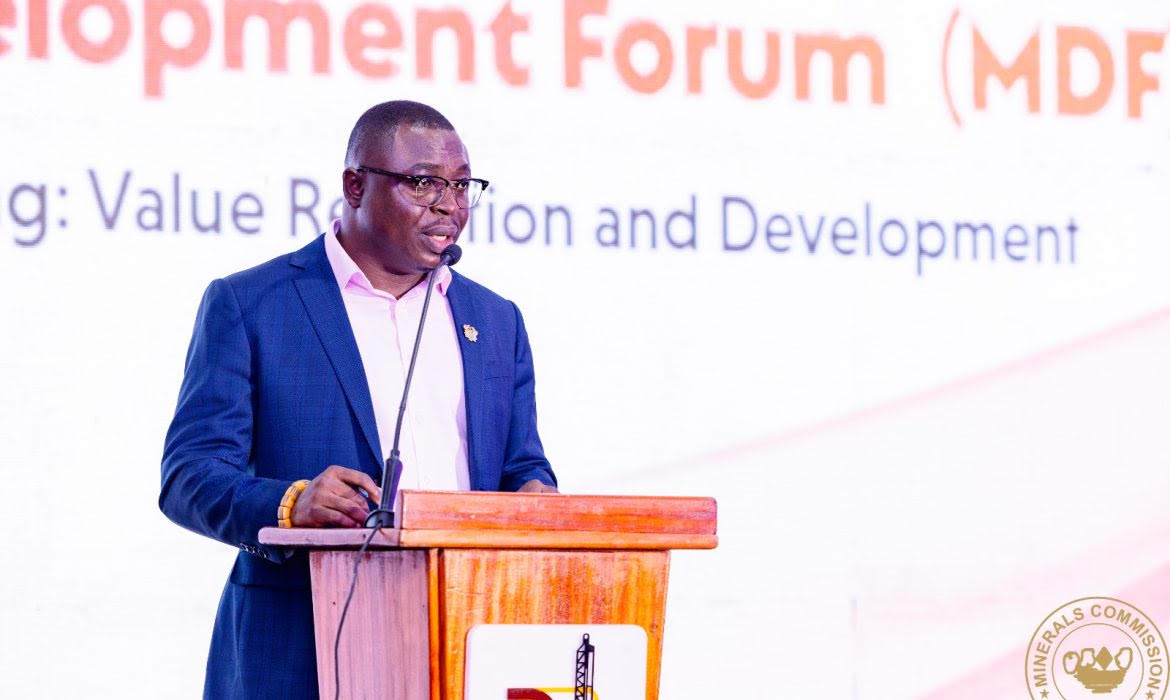
Deputy CEO for Support Services at the Minerals Commission, Emmanuel Kwamena Anyimah, made the observation at the National Mining Dialogue 2026 in Accra, where he called on mining companies to comply with Ghana’s laws, meet the conditions attached to their licences and contribute meaningfully to the country’s economic development.
He said companies must also promote local content and participation while protecting workers, host communities and the environment.
“The mineral rights granted by government are a privilege, not an absolute right. They come with binding conditions under Act 703,” Mr. Anyimah stated.
His comments come as Ghana seeks to increase local participation in the mining industry without adopting blanket nationalisation or wholesale expropriation of foreign-owned mining assets.
Instead, the country is increasingly using regulation, licensing conditions, local-content requirements, fiscal measures and stronger oversight to ensure that more value generated from Ghana’s mineral resources remains within the domestic economy.
Mining licences carry binding obligations
Mr. Anyimah explained that mining leases, mining support licences and other related permits are subject to a range of conditions.
These include compliance with laws and agreements, timely reporting and submission of data, adherence to health and safety standards, environmental protection and payment of statutory obligations.
The Minerals Commission exercises its regulatory mandate under the Minerals and Mining Act, 2006 (Act 703) and the Minerals and Mining (Health, Safety and Technical) Regulations, 2012 (L.I. 2182).
According to Mr. Anyimah, the objective is to ensure that mining contributes effectively to national development while safeguarding workers, communities and the environment.
Three pillars of regulatory engagement
Mr. Anyimah identified licence conditions, local content and local participation as three major pillars guiding the Minerals Commission’s engagement with large-scale mining companies.
Local content and participation, he said, are particularly important if Ghana is to derive broader economic benefits from its mineral wealth.
The Minerals and Mining (Local Content and Local Participation) Regulations, 2020 (L.I. 2431) establish the legal framework for increasing Ghanaian participation in the industry.
The framework covers areas including employment and skills development, procurement of locally produced goods and services, equity participation and technology transfer.
Moving beyond jobs to domestic value creation
The broader objective, however, extends beyond increasing the number of Ghanaians employed by mining companies.
A stronger local-content regime can help develop Ghanaian businesses capable of supplying mining operations, retain more foreign exchange within the economy, build specialised skills and create opportunities for local companies to participate further along the mining value chain.
When mining companies procure more goods and services locally, the economic benefits can extend to manufacturers, transport operators, engineers, financial institutions, contractors and other businesses.
The challenge is ensuring that local participation creates meaningful economic value rather than merely satisfying regulatory thresholds.
Mining’s wider economic contribution
Mining remains a major source of export earnings, government revenue and employment for Ghana.
However, the overall economic contribution of the sector depends not only on the volume of gold and other minerals extracted but also on how much value remains in the Ghanaian economy.
Effective compliance with licence conditions and statutory obligations is therefore important to ensuring that the state receives revenues needed to support public services and development.
At the community level, responsible mining can also contribute to infrastructure and livelihoods, provided such benefits are accompanied by effective environmental protection.
Mr. Anyimah stressed that Ghana remains open to responsible mining investment but said the industry’s success should ultimately be measured by its contribution to sustainable employment, Ghanaian participation, community development and long-term national prosperity.
Ghana adopts more assertive approach to resource governance
The National Mining Dialogue 2026 comes amid growing efforts by resource-rich countries to reassess how they manage foreign investment and maximise the domestic benefits of mineral extraction.
Ghana’s approach suggests that attracting international investment and protecting national interests need not be mutually exclusive.
Rather than restricting foreign capital and expertise, the country can establish clear rules requiring investors to operate within a framework that generates greater economic and social benefits for Ghanaians.
However, stronger regulation will only be effective if it is properly enforced.
Consistent monitoring, transparent reporting and accountability will be required to prevent local-content, environmental and other regulatory obligations from becoming mere box-ticking exercises.
Focus shifts to value retained in Ghana
The dialogue brought together government, traditional authorities, local communities and industry stakeholders to examine the country’s approach to mineral-resource governance.
Issues including environmental degradation, illegal mining, limited local ownership and the need to retain more value from mineral production remain central to the national debate.
For Ghana, the broader objective is increasingly about looking beyond the volume of minerals extracted.
The success of the mining industry should also be measured by the businesses, skills, jobs, technology, revenue and long-term development generated for Ghanaians.
The Minerals Commission, Mr. Anyimah said, remains committed to working with stakeholders to build a responsible, sustainable and resilient mining sector that delivers these outcomes.