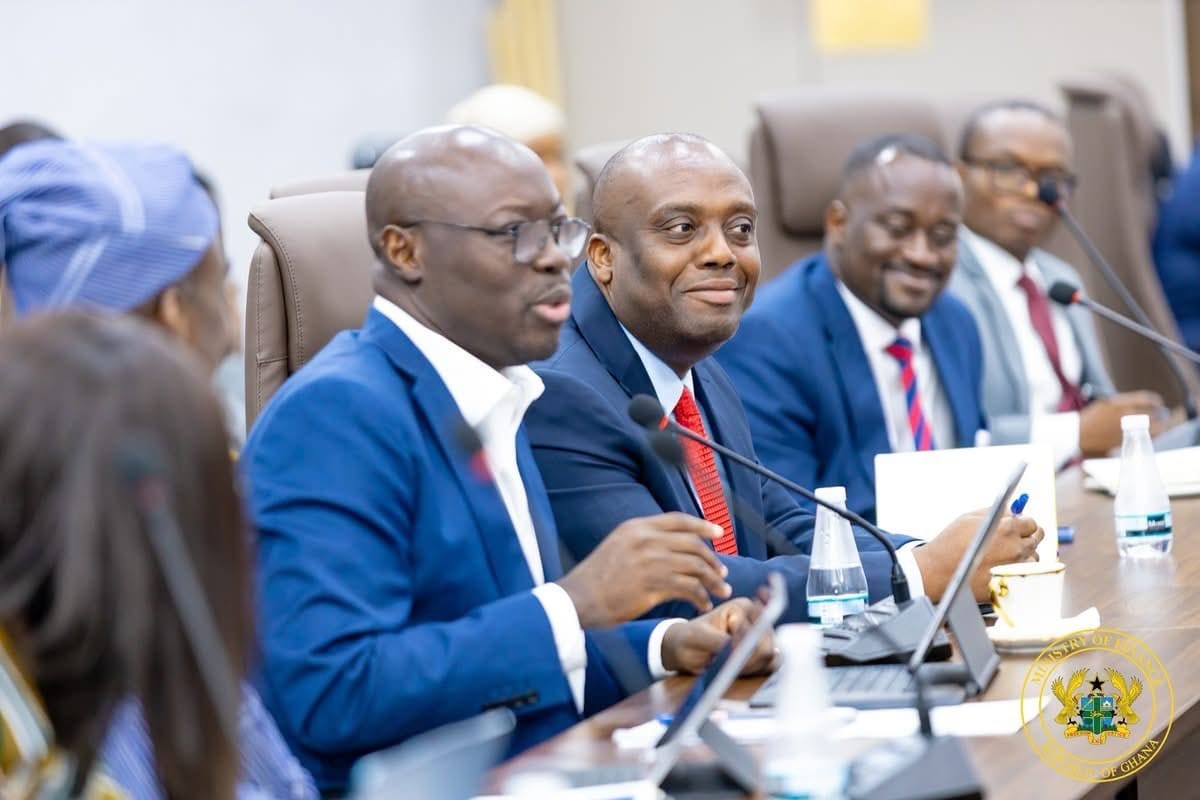

Finance Minister Dr. Cassiel Ato Forson has initiated high-level sectoral consultations with key ministries to transition the government’s proposed New Economy agenda from policy objectives into an actionable, multi-billion-dollar investment program.
Dr Ato Forson led a senior Ministry of Finance delegation—including his Deputy Minister and Chief Director—in a preliminary planning session with Elizabeth Ofosu-Adjare, Minister for Trade, Agribusiness and Industry. The move reflects the administration’s pivot from macroeconomic stabilisation toward scaling domestic manufacturing, expanding agro-processing, and driving wealth creation.
NEW ECONOMY AGENDA – INVESTMENT OVERVIEW
| Total Investment Mobilisation | $10 Billion over 4 years ($2.5 Billion annually) |
| Primary Pillar Allocation | $5 Billion (50%) dedicated to Agribusiness |
| Strategic Pillars | 7 Key Economic & Industrial Sectors |
| Next Operational Milestone | Structural Framework rollout in 2027 Budget |
Transitioning from stabilisation to structural transformation
Presenting the 2026 Mid-Year Fiscal Policy Review, Dr Ato Forson underscored that recent fiscal stabilisation measures served as a baseline required to support long-term investment.
“Stabilisation was never the destination. It was the price of entry. Ghana has paid that price. What comes next is the work that changes lives at scale — the work of transformation,” Dr. Ato Forson stated.
President John Dramani Mahama previously confirmed that the initiative will deploy $10 billion across seven strategic pillars over a four-year cycle, with $2.5 billion committed annually. Agriculture and value-added agro-processing are designated to receive 50% ($5 billion) of total allocations to expand irrigation networks, reduce import bills, and support youth employment in farming.
Structural details and upcoming 2027 Budget rollout
Inter-ministerial consultations are intended to establish clear project pipelines, governance rules, and funding models to ensure that capital deployment generates sustainable economic output without threatening debt sustainability.
Key details being finalised ahead of the 2027 Budget presentation scheduled for November include:
- Sectoral Framework: Specific project blueprints across industrial manufacturing, agribusiness, and digital infrastructure.
- Financing Architecture: Capital sourcing strategies designed to balance public investment with private equity participation.
- Fiscal Safeguards: Monitoring protocols to maintain fiscal discipline while expanding state-backed productive capacity.
The Ministry of Finance and the Ministry of Trade, Agribusiness and Industry are expected to continue cross-sector engagements ahead of the formal parliamentary presentation through the Ministry of Finance Ghana portal.


[…] economy grew by a provisional 6.0 per cent year-on-year in the second quarter of 2026, including oil and […]