

By Eugene Davis
The Minority Caucus has questioned why 87 of the 102 persons submitted by the National Sports Authority (NSA) on June 8 for World Cup visa facilitation could not be verified as NSA personnel, and why they were presented through the Authority.
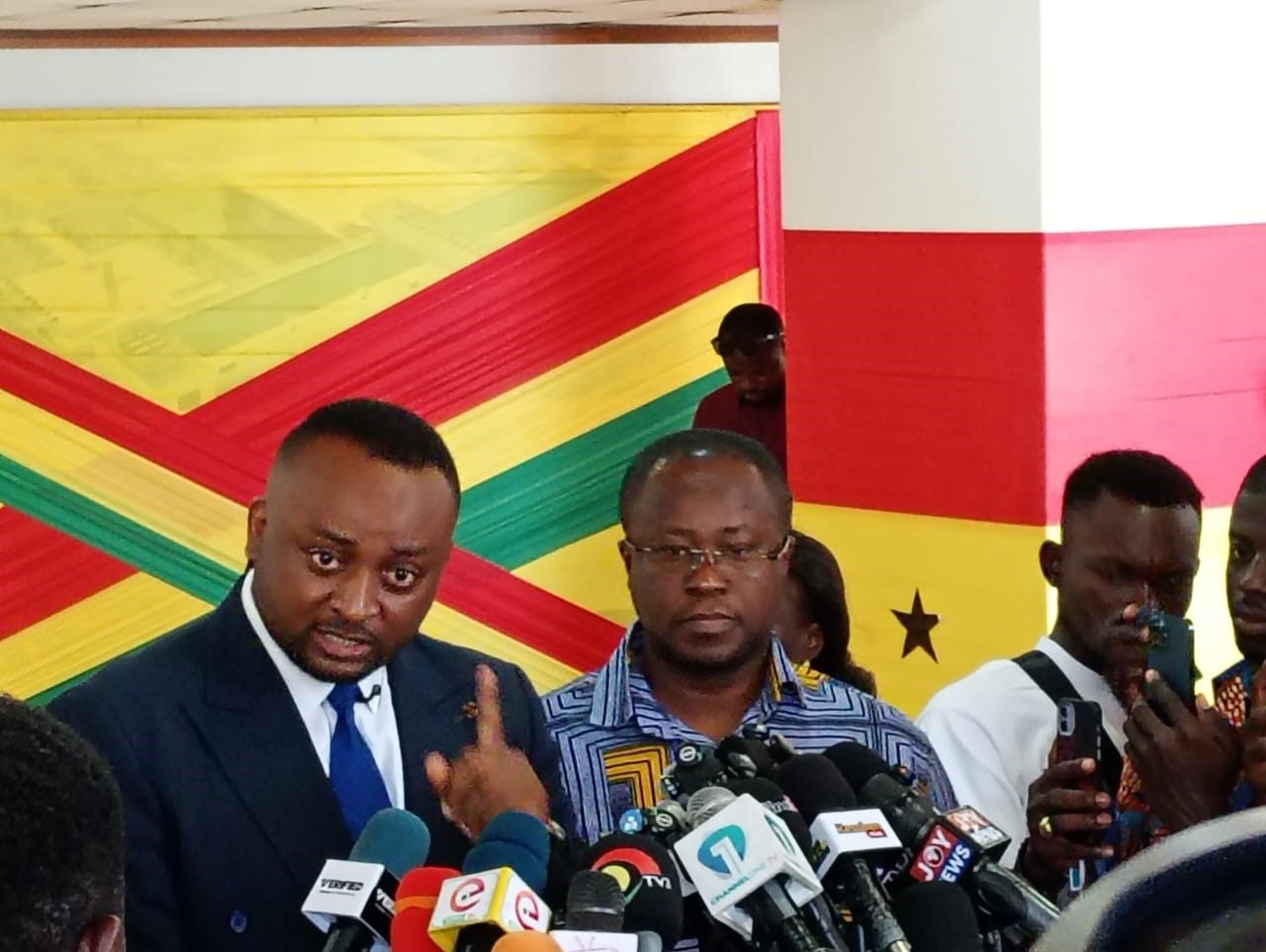
Addressing the media at a press conference at Parliament House in Accra, Ranking Member of Parliament’s Youth and Sports Committee Vincent Ekow Assafuah said the caucus’ central concern was the alleged use of the names, authority and credibility of Ghanaian public institutions in dealings with foreign diplomatic missions.
He said the issue went beyond the dismissal of NSA Director-General Yaw Ampofo Ankrah, whose removal by President John Dramani Mahama has been welcomed by the caucus, arguing that the dismissal should not bring an end to investigations into the World Cup visa arrangements.
According to the document underpinning the caucus’ concerns, the matter potentially involves the NSA, Ghana Tourism Authority (GTA), TRIBE Culture Fest, officials of the Ministry of Sports and Recreation and other individuals.
A key issue is the alleged presentation of people as NSA or GTA staff, personnel, volunteers or affiliates whose institutional status could not subsequently be verified.
The document says the US Embassy’s Fraud Prevention Unit identified discrepancies involving four applicants and requested evidence establishing their employment with the NSA. The Canadian Embassy later sought clarification on applicants’ employment status, roles and reasons for travel.
Visa arrangements
The process reportedly began with an engagement involving the US Embassy, TRIBE Culture Fest, the NSA and the GTA, with TRIBE introduced as a partner for activities linked to Ghana’s participation in the 2026 FIFA World Cup.
An NSA-TRIBE MOU was signed on June 2, 2025, establishing a strategic partnership around Ghana’s World Cup framework and granting TRIBE operational access to NSA facilities for approved activities.
The GTA also had an arrangement with TRIBE to facilitate visa processing and accommodation for GTA personnel travelling to the US and Canada. The document puts the stated cost at about US$3,000 per person for US-related arrangements and US$2,000 for Canada.
It alleges that the GTA submitted 50 names to the US Embassy as media personnel, but only two — Philip Narh and Andy Dosty — were identified as media practitioners. It further alleges that some individuals paid between US$8,000 and US$9,000 in connection with the arrangements.
These claims have not been established and are among the issues the caucus says require investigation.
The document also raises questions about the use of the GTA’s visa allocations, including the number of visas issued, rejected or used, who authorised the TRIBE arrangement, its contractual basis and the services provided.
A similar visa facilitation arrangement was subsequently entered into between TRIBE and the NSA, with stated costs of US$3,000 per person for the US and US$2,000 for Canada, covering accommodation, logistics and visa processing.
Questions over NSA personnel
The document alleges that some people presented as NSA personnel or affiliates were not employees of the Authority, while others were assigned institutional positions that, according to the document’s verification, did not exist within the NSA’s structure.
On January 28, 2026, an NSA email to the US Embassy introduced 22 personnel. The document identifies discrepancies in some of the titles and positions attributed to individuals on the list.
On March 18, the US Embassy’s Fraud Prevention Unit reportedly flagged four applicants and requested evidence establishing their employment with the NSA.
The following day, the NSA reportedly submitted a request to the Ministry concerning World Cup visa arrangements, accompanied by a list of 90 names. The document alleges that some individuals connected to the arrangements had paid about US$9,000.
On May 28, the Ministry reportedly wrote to the US Embassy seeking visa facilitation for NSA volunteers and event coordinators. The document subsequently raises questions about the inclusion of certain individuals and alleged payments, including an alleged part-payment of almost US$20,000.
The Canadian Embassy later asked the NSA to provide a fresh list identifying applicants’ current employment, roles, reasons for travel, and whether they were directly employed by the Authority or linked through an affiliate.
On June 8, the NSA submitted 102 names. The document says only 15 could be verified as NSA personnel, leaving 87 whose status could not be established.
It cites examples of individuals allegedly presented as Procurement Officers and a Chaplain, despite the stated verification that they did not hold those positions or, in some cases, were not NSA employees.
The document also raises questions about individuals allegedly presented as NSA personnel or affiliates, including Melissa Duker Amissah, while stressing that a familial relationship, on its own, does not establish wrongdoing.
It further alleges that several people who travelled to the US under the arrangement had not returned to Ghana, a claim it says should be independently verified through immigration and travel records.
Wider institutional questions
The caucus argues that the controversy should not be treated simply as a visa application issue or as the responsibility of one former NSA official.
Rather, it says the issues raised point to a broader institutional process involving the NSA, GTA, Ministry of Sports and Recreation, TRIBE Culture Fest and individuals connected to those institutions.
The central questions, therefore, are who authorised the submission of names, who verified the identities and institutional roles of applicants, why individuals whose NSA status could not be established were presented through the Authority, and whether money changed hands in connection with the arrangements.
The caucus is calling for the allegations and documentary trail to be subjected to a thorough investigation, with accountability determined on the basis of evidence.