
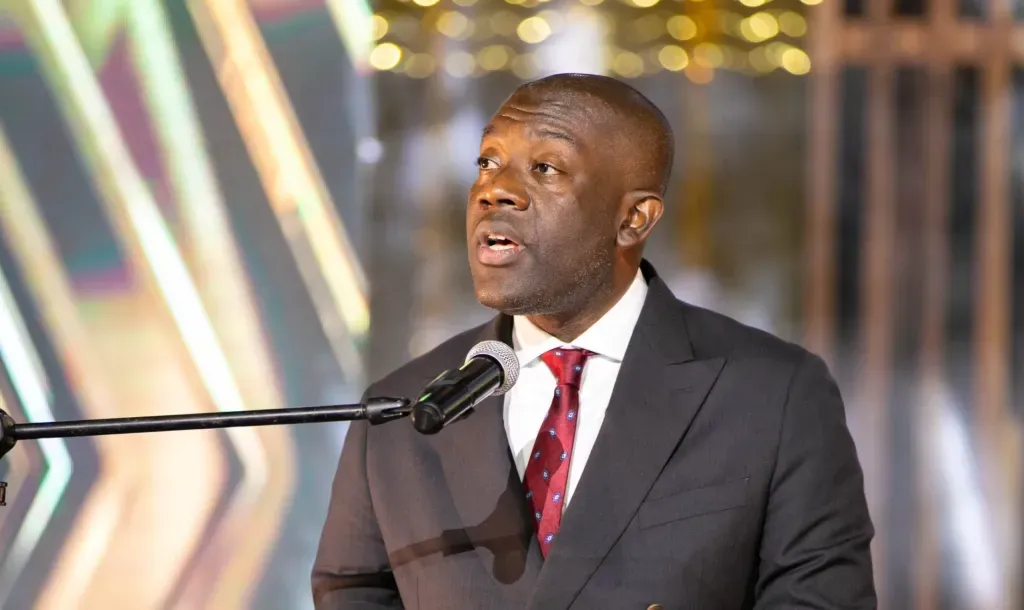

Former Works and Housing Minister Kojo Oppong Nkrumah has emphasized that the nation requires an open and transparent Saglemi Housing Project sales model to ensure that completed units reach ordinary Ghanaian families through structured mortgage financing. Speaking during a media interaction at Parliament House on Sunday, August 23, 2026, the Ofoase-Ayirebi Member of Parliament noted that the ongoing completion efforts under a Public-Private Partnership (PPP) framework fully validate the policy decisions taken by the previous administration.
PPP Framework Validated in Saglemi Housing Project Sales Model Strategy
Addressing journalists, Oppong Nkrumah highlighted that the decision to involve private sector capital to finish the stalled estate was originally met with intense political resistance. Opponents previously claimed the state was offloading public assets. However, the continuation of the Private Sector Participation (PSP) model to complete the initial 700 units demonstrates that private capital remains the most viable pathway to bridge infrastructure funding gaps without over-burdening public treasuries.
“It is clear evidence, first of all, that the PSP model that we put in place is being vindicated, contrary to all the stories that were told at the time and all the partisan smear that was put up,” Oppong Nkrumah stated.
The initial development scheme received $200 million in funding to deliver 5,000 homes. However, only 1,506 units were delivered in partially completed states before construction ground to a halt. Subsequent technical audits revealed that completing the structures and building bulk utility connections required an additional investment ranging between $60 million and $100 million.
“The major challenge at the time was how to find between $60 million and $100 million to revive the project,” Oppong Nkrumah explained. “It was clear that finding public-sector money to continue some of these projects was going to be difficult, so we came up with a public-private partnership to bring private-sector participation in.”
Demanding Open Access to Affordable Mortgages
To prevent favoritism and ensure national housing equity, Oppong Nkrumah urged current sector managers to establish a public allocation portal. Under a fair Saglemi Housing Project sales model, prospective buyers should be able to apply openly and secure home ownership through long-term mortgage options supported by commercial banking partners.
“There needs to be a transparent sales model where people can actually go, put in a bid and have an opportunity to purchase by mortgage any of these properties,” he stressed.
Mainstreaming PPPs to Solve National Housing Deficits
Beyond the immediate development at Saglemi, the former minister argued that adopting public-private execution models must become standard practice across all major national infrastructure operations. He noted that private execution speeds up delivery times while shielding public funds from unexpected budget overruns.
“One of the major things when it comes to public-private partnerships is speed,” Oppong Nkrumah noted. “A lot more attention needs to be paid to the question of how to speed up the processes.”
He concluded by advising political figures to support national development initiatives regardless of which administration initiated them. “If a model is rolled out, if a project is rolled out, and it’s good for Ghana, it’s good for Ghana,” Oppong Nkrumah added. “Let’s continue with it, and let’s give credit where credit is due.”
watch as This video on President Mahama Arrives at Saglemi Housing Project provides direct footage of the site inspection and project updates mentioned in the article.
Ensuring Sustainability in Public Infrastructure Delivery
The debate surrounding the Saglemi housing initiative underscores a broader necessity for long-term policy continuity across Ghana’s real estate sector. Infrastructure experts maintain that commercial partnerships provide critical insulation against economic volatility and budget shortfalls, allowing key public projects to reach completion despite changing political cycles.
Moving forward, establishing clear guidelines for private developers, ensuring competitive bidding processes, and safeguarding fair allocation mechanisms will remain essential. By prioritizing public accountability and financial transparency in the execution of the Saglemi Housing Project sales model, the ministry can restore public confidence and accelerate the delivery of safe, affordable housing options for citizens nationwide.