


By Christian Kpesese
The Public Interest and Accountability Committee (PIAC) has come under scrutiny from residents of Ablekuma West over how Ghana accounts for crude oil liftings, channels petroleum revenue into development, and monitors projects that remain unfinished years after they were awarded.
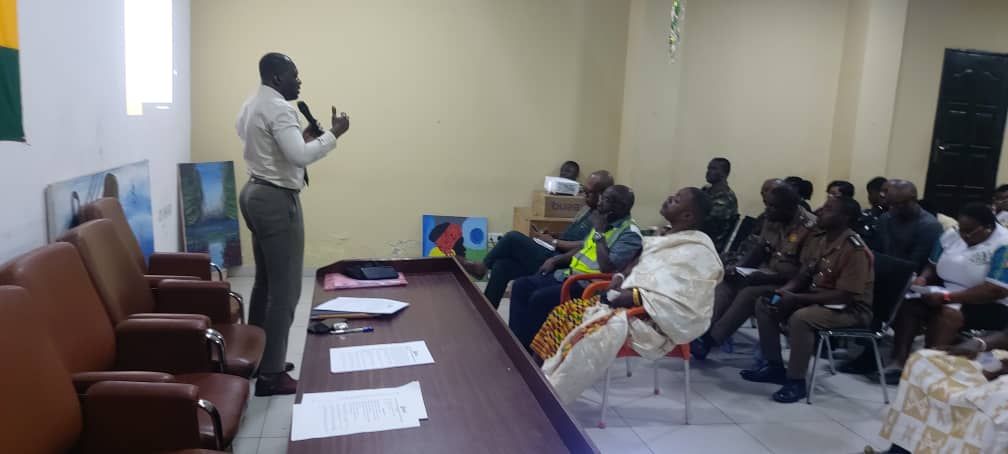
At a public forum organised by PIAC in the municipality to educate residents on the management and utilisation of petroleum revenue, residents questioned whether an independent accountability mechanism existed to verify oil volumes lifted and sold, warning that Ghana could lose substantial revenue if the process was not adequately monitored.
They also sought clarification on the age and purpose of the Ghana Heritage Fund and urged PIAC to extend its public engagements beyond formal assembly settings to reach more people at the community level.
Responding, Technical Manager of PIAC Mark Agyemang explained that Ghana uses measurement systems at different stages of oil production and sale to establish the volumes produced and transferred to buyers.
He said one meter measures oil as it comes from the production point, while another measures the volume transferred from a floating production, storage and offloading vessel (FPSO) into a buyer’s tanker.
According to him, the Ghana National Petroleum Corporation (GNPC) and the Ghana Revenue Authority (GRA), alongside other relevant stakeholders, participate in monitoring the measurement process.
Petroleum revenue does not go directly to assemblies
In a presentation, a member of PIAC, Mr Chris Opoku-Nyarko, explained that petroleum revenue is managed at the national level through the petroleum revenue management framework rather than transferred directly to individual Metropolitan, Municipal and District Assemblies (MMDAs).
Under the Petroleum Revenue Management Act, 2011 (Act 815), a portion of petroleum revenue is allocated through the Annual Budget Funding Amount (ABFA) to support national development priorities.
He said that, under the revised arrangement outlined at the forum, the entire ABFA allocation is dedicated to infrastructure projects under the government’s Big Push agenda, including roads, education, health and other critical sectors.
Assemblies such as Ablekuma West benefit through projects financed under the national development framework rather than receiving petroleum revenue directly into their accounts.
PIAC, he said, monitors ABFA-funded projects across districts to assess their implementation, ensure value for money and establish whether projects reported as completed exist on the ground.
The explanation sought to clarify the link between petroleum revenue and local development, particularly for residents who may expect oil money to translate directly into funds available to their assembly.
Old projects fuel public frustration
The forum also exposed concerns about the lengthy timelines associated with some development projects.
A representative of the Ablekuma West Municipal Assembly said some projects being handled by the authorities dated back to 2018, while others had been awarded before 2013.
He acknowledged the difficulty of explaining ongoing work to residents who did not feel its impact, particularly when projects had been initiated years before the current administration assumed responsibility.
The representative appealed for patience, explaining that the Assembly was still dealing with projects inherited from previous periods.
The account raised questions about project completion timelines and the need for clearer communication with residents about the status of development works, their funding and outstanding obligations.
At the forum, Mr. Nyarko also explained that projects could be physically completed while payments remained outstanding.
He indicated that contractors might still be owed money years after completing work, with outstanding payments reflected through the relevant project documentation.
Such cases highlight the importance of distinguishing between physical completion, financial settlement and the actual delivery of benefits to communities.
Heritage Fund and grassroots engagement
Responding to concerns about the Ghana Heritage Fund, Mr. Nyarko said it is expected to preserve part of the country’s petroleum wealth for future generations as oil resources are depleted.
The resident also called on PIAC to take its public education activities closer to ordinary people rather than relying primarily on formal assembly meetings.
The suggestion underscored the importance of engaging residents in markets, community gatherings and other accessible public spaces so that information on petroleum revenue, project selection and expenditure reaches people beyond organised forums.
The Ablekuma West engagement highlighted a central accountability challenge: explaining not only how petroleum revenue is collected and allocated, but also how citizens can track its conversion into completed projects and tangible improvements in their communities.
For residents, the ultimate test of petroleum revenue management is whether the money is properly accounted for and whether the development it is intended to support becomes visible in their daily lives.