


By Eugene Davis
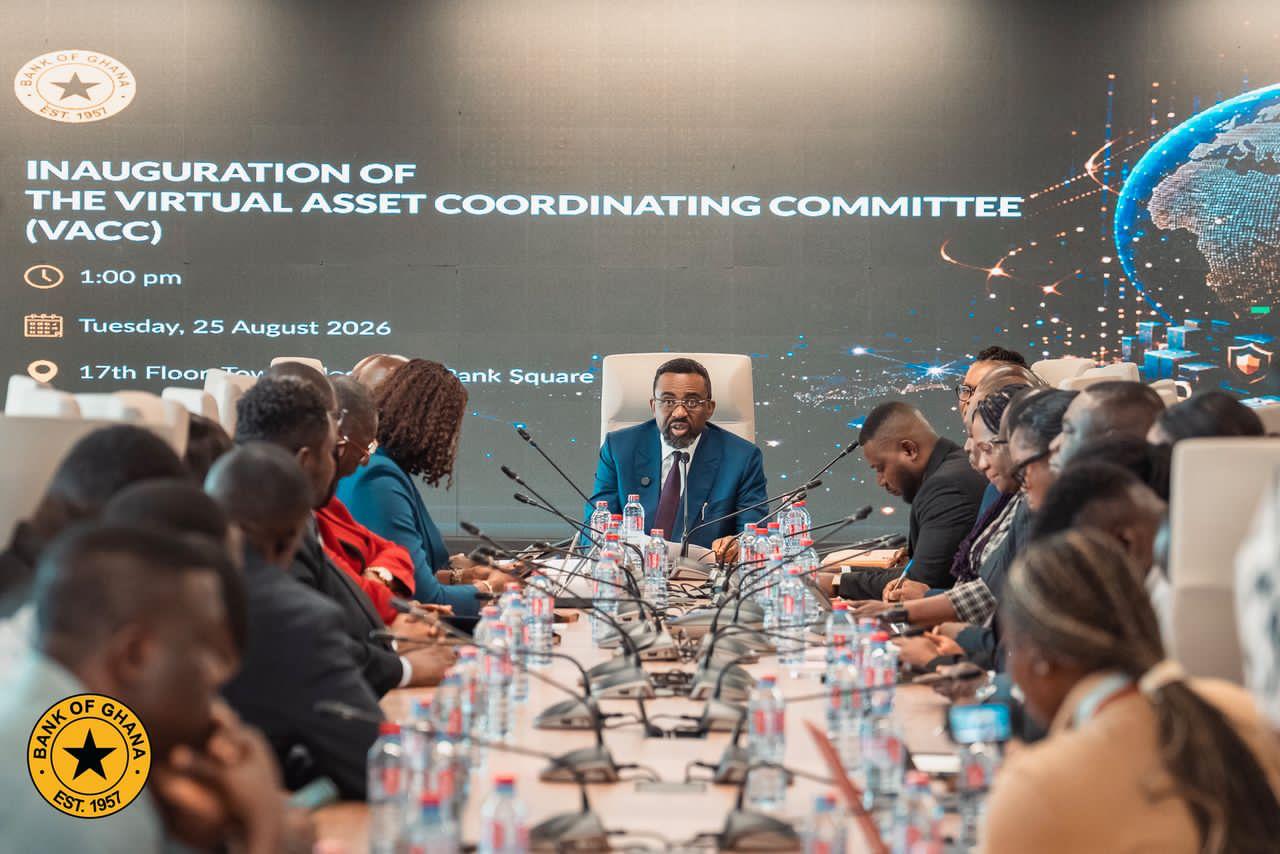
Virtual asset oversight in Ghana enters a pivotal phase as the inauguration of the Virtual Assets Coordinating Committee enhances the nation’s capacity to address money laundering, terrorist financing, cybersecurity, and consumer protection risks. Speaking at the launch, Governor of the Bank of Ghana, Dr Johnson Pandit Asiama, emphasised that coordinated supervision is vital for securing digital finance.
According to him, the committee is critical to the effective implementation of the Virtual Asset Service Providers Act, 2025 (Act 1154), providing the official statutory platform for regulatory and supervisory collaboration among key authorities.
Speaking at the inauguration of the Virtual Assets Coordinating Committee (VACC), Dr Asiama noted that the body will facilitate harmonised implementation of the law, strengthen inter-agency information-sharing, and enable robust virtual asset oversight across the financial sector.
“This inauguration marks an important transition from the enactment of legislation to the establishment of an effective, coordinated, and sustainable regulatory framework in Ghana,” he stated.
Strengthening virtual asset oversight from legislation to implementation
Ghana took a major step in its digital finance journey in December 2025 when the Virtual Asset Service Providers Act was enacted.
The legislation followed the National AML/CFT/PF Risk Assessment conducted in 2024, which identified significant adoption and usage of digital tokens alongside growing interconnectedness with formal banking. The assessment underscored the urgent need for structural virtual asset oversight aligned with global standards established by the Financial Action Task Force (FATF).
With Act 1154 now active, operational guidelines are being formulated by designated regulatory authorities—the Bank of Ghana and the Securities and Exchange Commission—while both institutions deploy regulatory sandboxes to achieve full operationalisation by 2027.
The transition aims to balance two essential goals: preventing digital tokens from becoming channels for illicit finance while providing regulatory certainty for legitimate innovation.
Multi-agency framework for virtual asset oversight
A key provision of Act 1154 is the establishment of the Virtual Assets Coordinating Committee, comprising representatives from the Bank of Ghana, the Securities and Exchange Commission, the Ministry of Finance, the Cyber Security Authority, and the Financial Intelligence Centre.
The committee may also co-opt other relevant state institutions as needed.
Dr Asiama highlighted that comprehensive virtual asset oversight requires cross-border and cross-agency alignment, given the multi-dimensional nature of digital markets. Under Section 5 of the Act, chairmanship will alternate between the central bank and the Securities and Exchange Commission, with the Bank of Ghana leading the initial two-year term.
As Chairman of the Financial Stability Council, Dr Asiama affirmed that rigorous virtual asset oversight remains essential to maintaining financial stability as digital transactions interact closely with conventional banking.
He urged members to execute their duties with urgency: “Effective coordination, timely information sharing, and a shared commitment to safeguarding our financial system will be essential to building an ecosystem that is safe, well-regulated, and supportive of growth.”
Economic implications of virtual asset oversight
As digital financial tools integrate further into conventional markets, transparent virtual asset oversight is crucial for sustaining economic stability and investor confidence.
A well-structured framework eliminates regulatory fragmentation and prevents unauthorised entities from operating in jurisdictional gaps. For Ghana, effective virtual asset oversight encourages responsible fintech development, attracts high-value technology investments, creates specialised jobs, and expands digital financial infrastructure.
Conversely, strong virtual asset oversight prevents capital flight, fraud, and cybercrime without driving legitimate business into informal channels. The ultimate success of Act 1154 and the VACC will depend on translating statutory mandates into active licensing, supervision, and enforcement mechanisms.


[…] in both the BoG and SEC regulatory sandbox frameworks positions One Africa Securities to support the development of formal guidelines covering […]
[…] the time the Virtual Asset Service Providers Act was passed in December 2025, Ghana’s virtual asset market was already up […]